

Fundraiser & Benefit Dinner Venues in Downtown Nashville (2026)
Every private event has a budget. A fundraiser has a budget that other people get to look at.
That is the part that makes booking a benefit dinner different from booking any other private event in downtown Nashville. A rehearsal dinner answers to the couple. A corporate dinner answers to a department head. A benefit dinner answers to a board, a finance committee, a development director with a cost-per-dollar-raised number to defend, and sometimes a room full of donors who are quietly doing the math on what the evening must have cost. Pick the wrong venue and the event still happens — it just happens with an awkward slide in the next board meeting.
So this guide is not a list of pretty rooms. It is a practical walk through the decisions that actually determine whether a fundraiser dinner in downtown Nashville holds up to scrutiny: how to choose between a small cultivation dinner and a full benefit, how to get a venue cost you can forecast before you spend a dollar, how the program works in a room without a microphone, and which night of the week quietly saves you the most money.
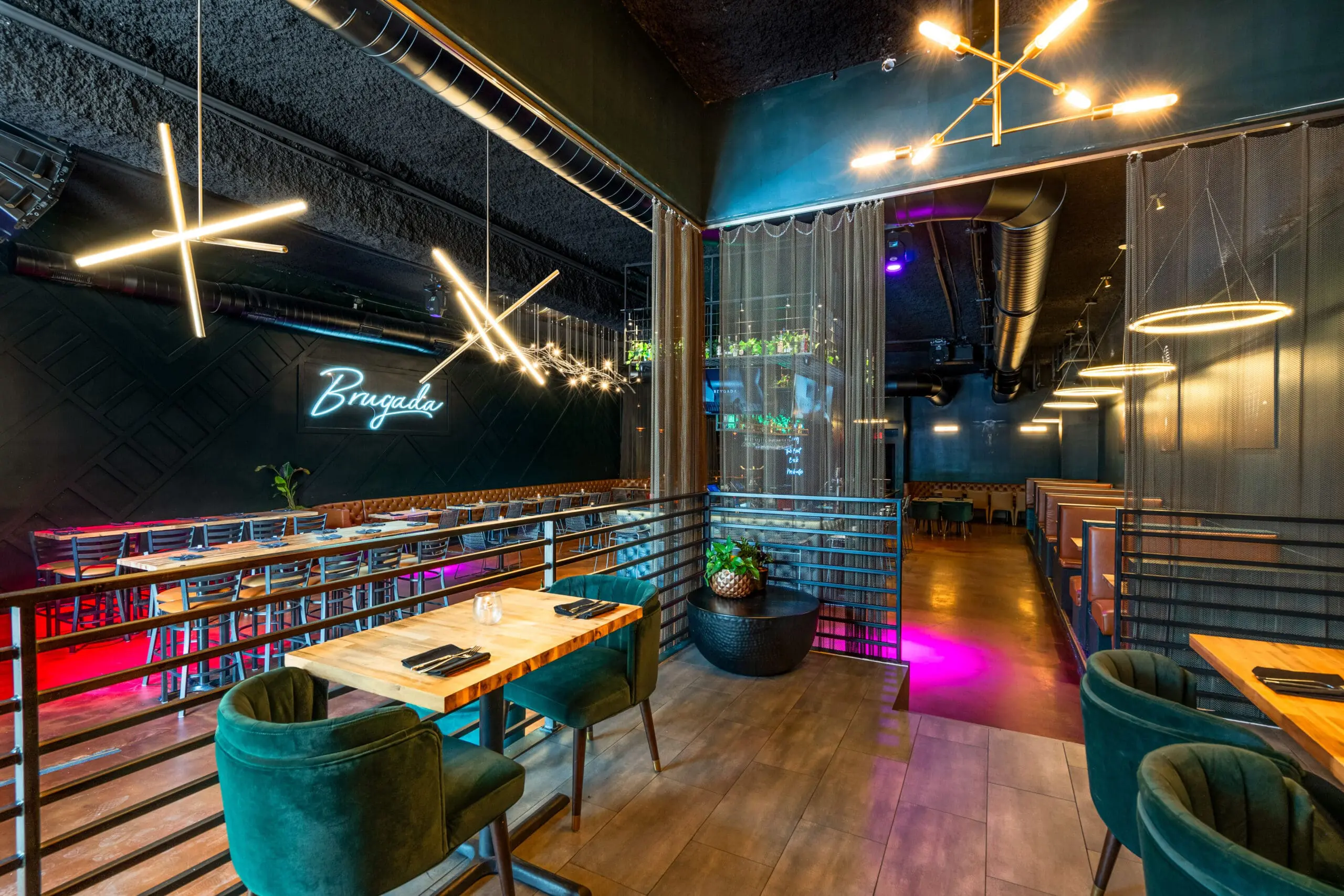
Brugada Kitchen & Bar sits at 204 Commerce Street, one block off Lower Broadway, with four private spaces and a full-venue buyout — which means the same venue can host a ten-person donor dinner in January and a three-hundred-guest reception in the fall. Here is how to decide which one your organization actually needs.
Start with the only number that matters: cost to raise a dollar
Development teams already know this metric; boards increasingly ask for it by name. Every dollar spent on the room, the food and the beverage is a dollar that did not reach the mission, and the ratio between the two is the number that survives into the annual report.
What that means in practice is that the venue question is not “what is the nicest room we can get?” It is “what is the smallest, most certain amount of money we can spend to put the right people in a room long enough to ask them for something?”
Two things follow from that, and they are the two things most fundraiser planners get backwards:
- Bigger is not better. A 150-guest gala can easily cost more to produce than a series of four intimate cultivation dinners that raise more money, because a gala’s cost scales with headcount while a cultivation dinner’s return scales with who is at the table. If your top twelve donors account for most of your revenue, the right room may hold twelve people.
- Certainty beats cheapness. A venue that quotes you a low per-head number and then adds line items is worse for a board presentation than a venue that tells you a single minimum spend up front. You can approve a known number. You cannot approve an estimate.
Why a stated minimum spend is a feature, not an obstacle
Our private dining page states it plainly: minimum spend requirements vary based on the day, time, and event space selected. Development professionals sometimes read that as a hurdle. It is the opposite.
A minimum spend is a ceiling you control and a floor you can plan against. It converts “the venue will cost something” into a single figure that goes into a budget line, gets approved once, and does not move. It is also the number that lets you decide honestly whether to shrink the guest list, move to a Tuesday, or choose a smaller room — all decisions that are easy to make in advance and painful to make two weeks out.
The practical move: ask for the minimum spend for your specific date and room before you commit to a guest count. Then build the guest list to fit the number, not the other way around.
The three formats a fundraiser actually takes
Nearly every nonprofit event we are asked about falls into one of three shapes. They are not the same event at different sizes — they are different events, with different rooms, different economics and different goals.
1. The cultivation dinner (8–20 guests)
A small, seated, deliberately quiet dinner for major donors, prospective board members, or a handful of people you intend to ask directly. No program, no slideshow, no production. The executive director speaks for four minutes between courses and the rest of the night is conversation.
This is the highest-return format per dollar spent and the most under-used. Skull Nook seats 10 and Singer’s Lounge seats 20, and both of these rooms offer à la carte ordering from the full menu — which matters here, because at this size you want guests ordering what they want rather than eating a set menu.
2. The benefit dinner (30–60 guests)
A seated dinner with an actual program: a welcome, a mission moment, a beneficiary or a video, and an ask. This is the format where room choice stops being about capacity and starts being about whether the program lands.
The VIP Room seats 40 and is equipped with a screen for presentations, which makes it the right answer any time the evening includes an impact video or a slideshow — even if your headcount would technically fit somewhere smaller. The Main Dining Room seats 60 and moves comfortably between a structured seated dinner and a standing reception.
3. The gala or benefit reception (100–300 guests)
A standing or mixed-format evening built around volume, visibility and energy: sponsor recognition, a bar, circulation, music. A full venue buyout seats 150 or holds 300 standing, and includes a professional DJ setup — dedicated sound connection points and a designated DJ area, with our team coordinating setup and breakdown in advance.
Be honest with yourself about which of the three you are planning. A great many nonprofits budget for a gala and actually need a cultivation dinner.
Rooms, capacities and service formats at a glance
| Space | Seated | Standing | Service formats | Best fundraiser use |
|---|---|---|---|---|
| Skull Nook | 10 | 15 | À la carte (full menu) · three-course prix fixe · buffet / station (open bar optional on the last two) | Major-donor cultivation dinner; board chair’s private ask |
| Singer’s Lounge | 20 | 25 | À la carte (full menu) · three-course prix fixe · buffet / station (open bar optional on the last two) | Prospect dinner; new-board-member welcome; small donor thank-you |
| VIP Room | 40 | 50 | Three-course prix fixe · buffet / station (open bar optional) — equipped with a screen for presentations | Benefit dinner with an impact video or slideshow |
| Main Dining Room | 60 | 120 | Three-course prix fixe · buffet / station (open bar optional) | Annual dinner; mixed seated-and-mingling benefit |
| Full Venue Buyout | 150 | 300 | Three-course prix fixe · buffet / station (open bar optional); professional DJ setup included | Gala, benefit reception, sponsor-driven evening |
One format note worth catching early, because it changes how you budget: only Skull Nook and Singer’s Lounge offer à la carte ordering from the full menu. The VIP Room, Main Dining Room and full-venue buyout run on a three-course prix fixe or buffet / station service. That is not a limitation so much as a budgeting gift — a prix fixe gives you a per-guest food cost you can multiply before the invitations go out.
The ask: how a program works in a room with no microphone
This is the part most venue guides skip and most fundraisers discover too late, so here it is plainly: Brugada does not provide microphones. Not in any room, not for any event size.
That is a real constraint, and it should shape your room choice rather than surprise you on the night. In practice it works out like this:
- Up to roughly 20–25 guests (Skull Nook, Singer’s Lounge), a person speaking normally from their seat is heard by the entire table. This is the ideal acoustic environment for an ask, because an unamplified voice at a small table is intimate in a way a microphone can never be.
- At 40 guests (VIP Room), remarks still work — but place your speaker centrally rather than at one end, keep the program to a few short segments rather than one long address, and lean on the screen to carry the emotional weight. An impact video does what a microphone cannot.
- Beyond 60 guests, a formal program needs planning. If your evening depends on a podium moment reaching 150 people, raise it in your inquiry early so the format and sound approach are designed in rather than improvised. The buyout’s DJ setup is built for a DJ to plug into, not as speech reinforcement.
For an unusually large share of nonprofit events, this constraint is quietly good news. The small, unamplified dinner is both the cheaper event and the one where people actually say yes.
Choosing the night — where the real savings are
Downtown Nashville prices a Saturday in December the way you would expect it to. The organizations that run efficient events tend to be the ones that stopped insisting on Saturdays.
Our service week runs Tuesday through Thursday from 4:30 pm to 9 pm, with Friday, Saturday and Sunday opening at 10 am for brunch and running through dinner and later. Mondays we are closed. A few consequences for fundraiser planning:
- A Tuesday or Wednesday evening is the least contested slot downtown — and your donors’ calendars are often freer midweek than on a weekend night that competes with every other event in the city.
- The 4:30 to 9 pm weeknight window is genuinely enough for a cultivation dinner or a benefit dinner with a program. A 6:00 arrival, 6:30 seating, program at 8:00 is a complete evening.
- December is the scarcest month of the year downtown. If your event is tied to year-end giving, either book it unusually early or — better — hold the dinner in January or February, when rooms are available, downtown is quiet, and you have your donors’ full attention. A January cultivation dinner that opens a conversation is often worth more than a December one that competes with four holiday parties on the same night.
If what you need is a daytime function — a volunteer appreciation lunch, a donor breakfast, a board working session with food — note that we do not serve weekday lunch or breakfast. Those go to catering instead, where the kitchen comes to your office or venue.
Food, beverage and the line items a board will read
Our kitchen is modern American, and the menu changes seasonally — the current dinner menu is the place to look before you choose a format. For a seated benefit dinner, the three-course prix fixe is the format that makes budgeting trivial: one number per guest, multiplied by a guest count you control.
On beverage, you have genuine choices, and they are the easiest place to move your total. An open bar is optional on prix fixe and buffet / station service — meaning you can also run a cash bar, a limited beverage package, or wine service with dinner only. Our drinks list includes handcrafted cocktails, wine, beer and non-alcoholic alternatives, and a thoughtfully limited list is not a lesser event; at a fundraiser it often reads as good stewardship.
If your event is a weekend brunch rather than a dinner — a donor thank-you brunch or a volunteer celebration — our brunch menu is available Friday through Sunday, and large groups are served from our large group menu, a curated selection of favorites from our full menu.
How your organization records and reports the cost of the event is a question for your own finance team or advisor. What we can do is give you a clear invoice that matches what you were quoted.
Location: why downtown matters for a donor list
204 Commerce Street is one block off Lower Broadway, roughly half a mile from Music City Center, and directly across Commerce Street from Dolly Parton’s SongTeller Hotel — which matters when your board includes out-of-town members or your honoree is flying in. (We are an independent restaurant and not affiliated with the hotel.) Downtown hotels, garages and rideshare access are all within a short walk, and a guest who does not have to solve a parking problem arrives in a better mood for an ask.
It also means the evening can end well. Guests who want to continue the night have all of Broadway a block away; guests who are done can be back in a hotel lobby in minutes.
What to include in your inquiry
Fundraiser inquiries get answered fastest and most accurately when they arrive with the details that actually determine the quote. Include:
- Your organization and the purpose of the evening (cultivation, annual benefit, gala, thank-you)
- Target date plus two alternates — and say whether a weeknight is acceptable, because it usually improves what we can offer
- Guest count, with your realistic floor and ceiling
- Whether there is a program, and whether it includes a video or slideshow (this decides the VIP Room)
- Your approved budget or the minimum spend you can clear — tell us the real number and we will tell you honestly what fits
- Service format preference: à la carte, three-course prix fixe, or buffet / station
- Beverage approach: open bar, limited package, wine with dinner, or cash bar
- Anything you plan to bring in — signage, a check presentation, a silent auction table, a cake — so we can confirm what works in the space
Start that conversation through our private events inquiry form, or read more about the spaces on our private dining page. For an ordinary table — a planning dinner for two before you commit to anything — you can book a reservation directly.
Frequently asked questions
Do you host fundraisers and benefit dinners?
Yes. Our private spaces accommodate 10 to 100+ guests, and a full-venue buyout holds up to 300 standing — which covers everything from a twelve-person donor cultivation dinner to a gala-scale benefit reception. Submit the details through our private events inquiry form.
What does a fundraiser dinner cost at Brugada?
There is no single number, because minimum spend requirements vary based on the day, time, and event space selected. That is why we recommend telling us your date, guest count and approved budget in the inquiry — you will get a figure you can take to a board rather than a range you have to hedge.
Which room should a nonprofit choose?
Work backwards from the program. No program and a small list of major donors: Skull Nook (10) or Singer’s Lounge (20). A program with a video or slideshow: the VIP Room (40), which is equipped with a screen. A larger annual dinner: the Main Dining Room (60 seated, 120 standing). A gala: the full venue buyout (150 seated, 300 standing).
Is there a microphone for the ask or the program?
No — Brugada does not provide microphones in any space. Choose your room accordingly: up to about 20–25 guests an unamplified voice carries easily; in the VIP Room at 40, position the speaker centrally and keep remarks short. For larger programs, raise it in your inquiry so the format is planned around it.
Can we show an impact video or a donor slideshow?
The VIP Room is equipped with a screen for presentations, so that is the room to ask for whenever the evening includes a video or slideshow — even at headcounts that would otherwise fit a smaller space. Confirm the technical details for your specific event in your inquiry.
Can we do a silent auction or a check presentation?
Tell us what you are planning in the inquiry — table space, signage, a check presentation moment and similar elements are all worth confirming for your specific room and date rather than assuming. Our events team will tell you what works in the space you are considering.
What is the most cost-efficient way to run a fundraiser dinner here?
A midweek evening (Tuesday through Thursday, 4:30 to 9 pm), a smaller room, a three-course prix fixe so your per-guest food cost is fixed in advance, and a limited beverage package rather than a full open bar. That combination gives you a total you can forecast exactly.
Should we book our fundraiser in December?
Only if you book very early. December weekends downtown are the scarcest inventory of the year. If your event supports year-end giving, consider holding the dinner in January or February instead — availability is better, costs are more forgiving, and your donors are far less distracted.
Can you host a daytime donor breakfast or volunteer lunch?
Not on a weekday — we open at 4:30 pm Tuesday through Thursday and are closed Mondays. Weekday daytime functions are best handled through catering. On Friday, Saturday and Sunday we open at 10 am, so a weekend brunch event is possible.
Do you offer a discount or donated space for nonprofits?
Anything of that kind is decided case by case, so please ask directly in your inquiry rather than assuming either way — and include your organization and the purpose of the evening so the request has context.
How far in advance should we book?
Weekend evenings and peak event dates book quickly, so inquire as early as you can — several months out for a fall or December event, and ideally as soon as your board approves the budget. Midweek dates in January and February are the most forgiving.
How do we start?
Send your date, guest count, program needs and budget through the private events inquiry form. Our events team handles every private event directly, from the first inquiry through the final toast.
Plan your fundraiser at Brugada
A benefit dinner that works is not the most expensive one. It is the one where the room fit the ask, the cost was known before anyone sat down, and the people who needed to be in the conversation stayed in it all night.
If that is the evening you are planning, tell us about it: submit a private events inquiry, browse the spaces on our private dining page, or call us at (615) 678-8952. Brugada Kitchen & Bar, 204 Commerce Street, Nashville, TN 37201 — one block off Lower Broadway. For an ordinary dinner reservation, book a table any time.
Book a table
*Powered by OpenTable
